Current sense transformers

Current sense transformers are typically inserted into the primary power circuit of a high-frequency transformer, but their use can be extended to AC current measurements in applications that do not require particularly accurate detection.

By connecting a resistor to the transformer’s secondary winding, a floating voltage signal is obtained, proportional to the primary current. The signal can then be electronically conditioned or processed via software and used to protect electronic switches or perform current-based controls.

The turns ratios of these transformers are typically 1:50, 1:100, 1:200, 1:500, or 1:1000.

As the number of turns increases, the transformer’s optimal operating frequency shifts toward lower frequencies. Since the load resistance determines the transformer’s output voltage, once the minimum operating frequency is known, the maximum output voltage can be determined, allowing the sensing circuit to operate without signal distortion.

The maximum operating frequency is primarily determined by the performance of the core material and the capacitive effect created by adjacent turns of the winding, which limits the transformer’s bandwidth.

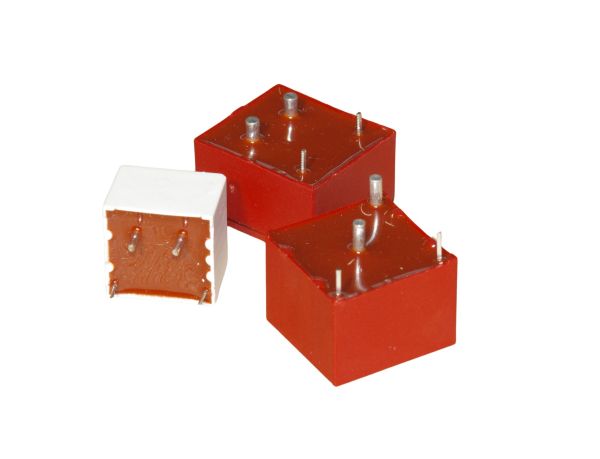
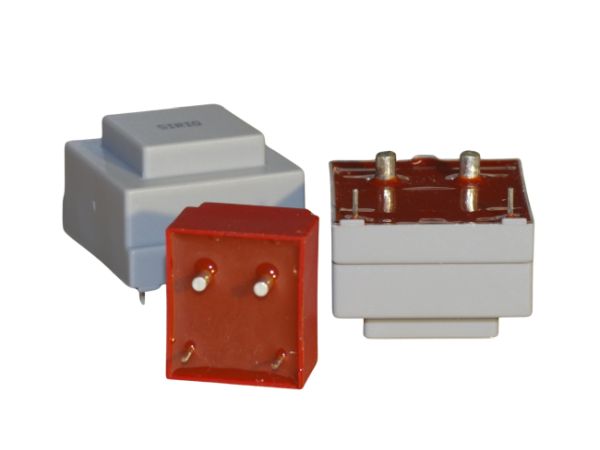
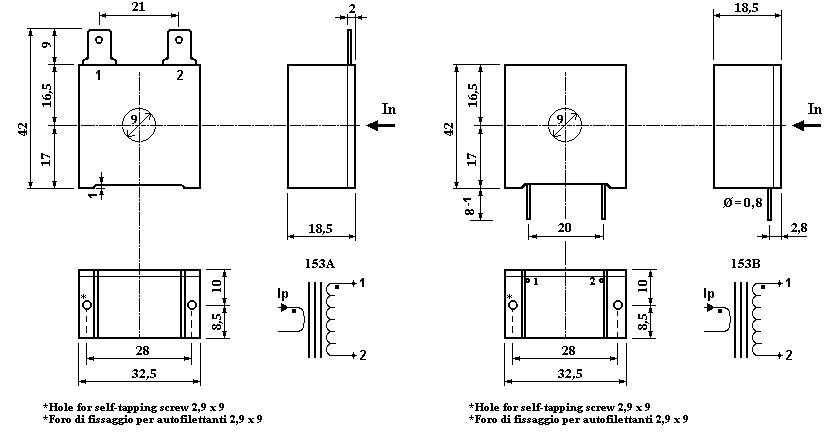
From a construction standpoint, these current transformers are built either on a toroidal core, or an E core with molded-in primary turn. This solution is particularly suitable for applications where, in order to contain costs, robust and easy-to-mount components are required.

The typical operating temperature ranges from –25 to +85°C.

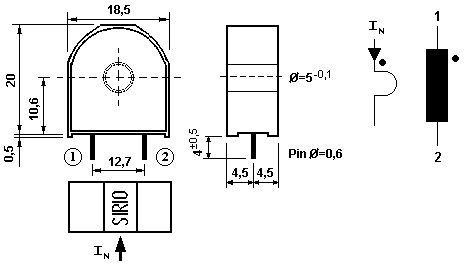
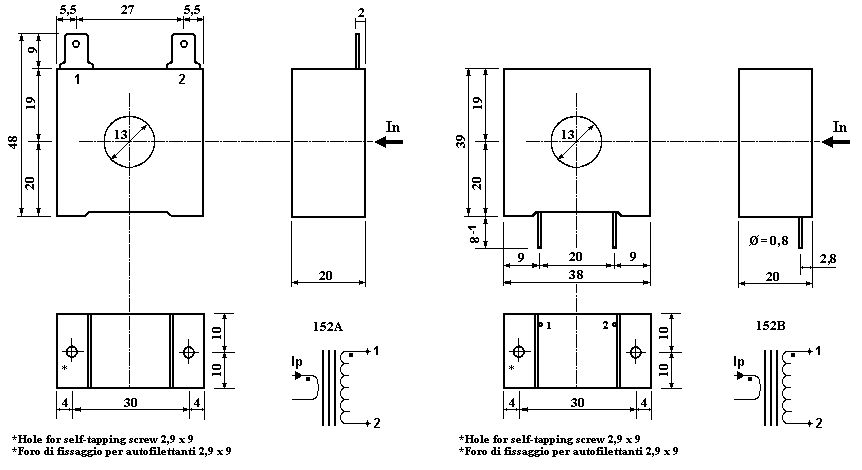
Some standard codes in the toroidal version with through hole

Rated primary current Ip = 20Arms
CodeIp
[Arms]
nLs
[mH]
fmax
[KHz]
Vt
[μVs]
DrawingD
[mm]
Uis
[Vrms]
Up
[Vrms]
TA 15051120(1) : 501,910001801508FA510004500
TA 15051220(1) : 1007,54004001508FA510004500
TA 15051320(1) : 20030,01008501508FA510004500
TA 15052120(1) : 504,55001601508FA510004500
TA 15052220(1) : 10019,02003601508FA510004500
TA 15052320(1) : 20076,0507501508FA510004500
TA 15052420(1) : 500475,01018001508FA510004500
Rated primary current Ip = 70Arms
CodeIp
[Arms]
nLs
[mH]
fmax
[KHz]
Vt
[μVs]
DrawingD
[mm]
Uis
[Vrms]
Up
[Vrms]
TA 15320170(1) : 5011,5500650153A910004500
TA 15320270(1) : 100452001300153A910004500
TA 15320370(1) : 200180502700153A910004500
TA 15320470(1) : 5001130207500153A910004500
TA 15320570(1) : 100045001015000153A910004500
TA 15320670(1) : 5011,5500650153B910004500
TA 15320770(1) : 100452001300153B910004500
TA 15320870(1) : 200180502700153B910004500
TA 15320970(1) : 5001130207500153B910004500
TA 15321070(1) : 100045001015000153B910004500
Rated primary current Ip = 100Arms
CodeIp
[Arms]
nLs
[mH]
fmax
[KHz]
Vt
[μVs]
DrawingD
[mm]
Uis
[Vrms]
Up
[Vrms]
TA 152009100(1) : 10031602250152A1310004000
TA 152059100(1) : 200124254500152B1310004000

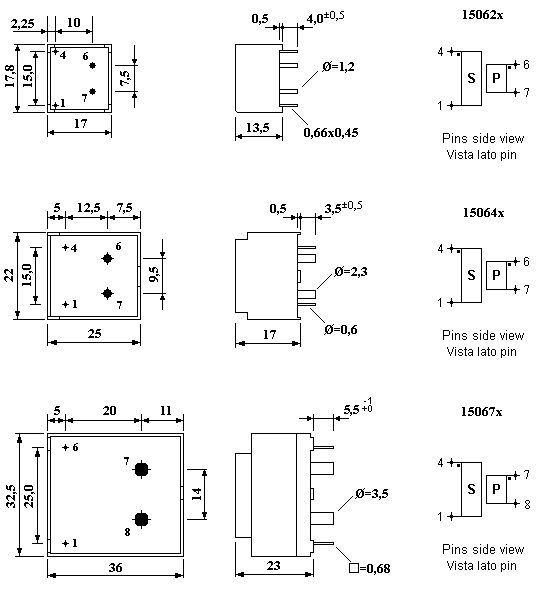
Some standard codes in the linear version with the loop inserted

Rated primary current Ip = 20 Arms
CodeIp
[Arms]
nLs
[mH]
fn
[KHz]
Vt
[μVs]
DrawingD
[mm]
Uis
[Vrms]
Up
[Vrms]
TA 150621201 : 100105 ÷ 10055015062X1,24404000
TA 150622201 : 200401 ÷ 50110015062X1,24404000
TA 150625201 : 100010000,05 ÷ 10600015062X1,24404000
Rated primary current Ip = 50 Arms
CodeIp
[Arms]
nLs
[mH]
fn
[KHz]
Vt
[μVs]
DrawingD
[mm]
Uis
[Vrms]
Up
[Vrms]
TA 150641501 : 100105 ÷ 10085015064X2,34804680
TA 150642501 : 200401 ÷ 50190015064X2,34804680
TA 150645501 : 100010000,05 ÷ 10900015064X2,34804680
Rated primary current Ip = 70 Arms
CodeIp
[Arms]
nLs
[mH]
fn
[KHz]
Vt
[μVs]
DrawingD
[mm]
Uis
[Vrms]
Up
[Vrms]
TA 150671701 : 100105 ÷ 100140015067X3,56005000
TA 150672701 : 200401 ÷ 50280015067X3,56005000
TA 150675701 : 100010000,05 ÷ 101400015067X3,56005000
The characterization of the high-frequency current transformer refers to the following quantities:
  • n ratio between primary current and secondary current (it typically corresponds to the number of turns of the secondary winding)
  • RS secondary winding resistance
  • IPrms primary current rating
  • LS secondary winding inductance
  • fn nominal operating frequency (or optimal frequency range)
  • Vt minimum secondary transfer area referred to a temperature of 25°C
  • Uis maximum operating voltage
  • Up insulation voltage
  • D diameter of the through-hole or primary turn (in the version with molded-in turn)
Would you like to receive the datasheet of these components? Haven’t you found the features you need, but you would like to get a transformer of such a size? Please, send an e-mail to our Technical Department.

High-Frequency CT